Important: the content reported in this page refers only to the regular PhD program in Computer Science of the University of Milan. If you are a PhD student working in the Department of Computer Science but under a National or Intersectoral PhD program, you should refer to the specific guidelines of your program.
Responsabilities of a PhD student and a few general information about PhD in Italy:
- In Italy, PhD degrees are awarded in cycles, or "cicli" in Italian, which are reported in Roman numerals (e.g., 40=XL, 41=XLI). Active cycles are: XXXVIII (38°), XXXIX (39°), XL (40°), XLI (41°).
- The PhD program lasts for three years. Each academic year normally starts on October 1st.
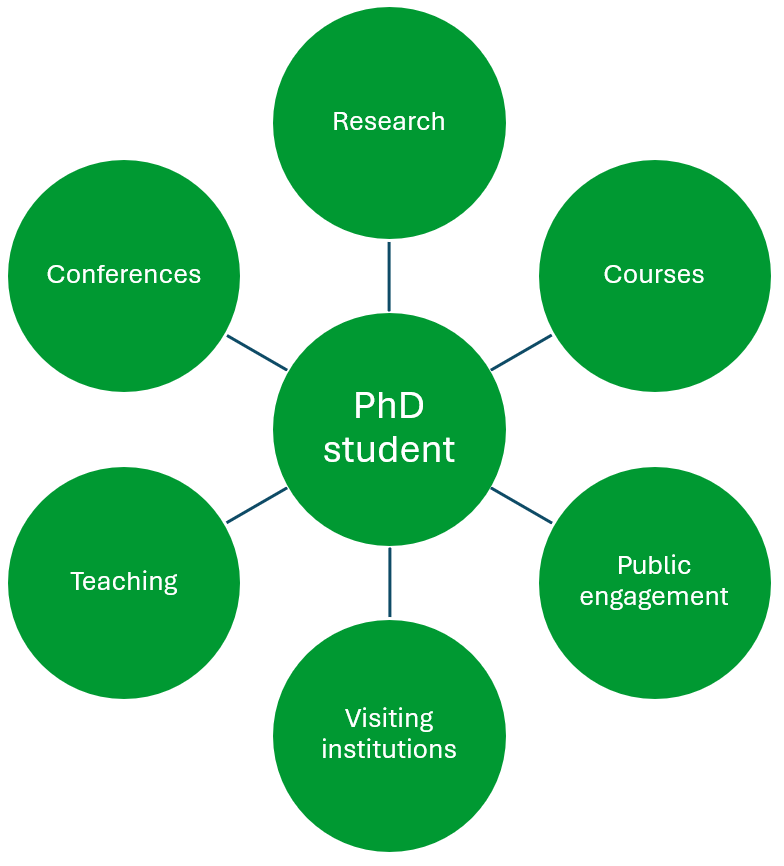
- PhD students:
- perform scientific research which should possibly end with scientific publications.
- attend courses and pass the exams.
- optionally, but highly recommended, present their research at National and/or International Conferences.
- optionally, but highly recommended, visit other research centers/companies abroad for about 6 months.
- optionally, but highly recommended, participate to public engagement activities (e.g., MeetMeTonight).
- optionally, perform teaching assistance and/or limited external work activities.
Important:The University of Milan has a Doctoral Regulation (“Regolamento del Dottorato”), which can be found (in Italian) at this link. It is a good idea to check it out when specific needs arise. In particular, article 22 lists the rights and duties of Doctoral students.
The following is a NOT comphrensive summary of some of the most important aspects:
- The PhD program is a full-time activity consisting in 1500 conventional hours a year (that is: every working hour in a year).
- The PhD program is NOT compatible with other remunerated activities, unless prior official authorization. Only some forms of teaching assistance (see here) and limited external work activities (see here), can be considered for authorization by the PhD board.
- The PhD activities can be suspended only for relevant personal or family issues (e.g., maternity/paternity leave, health, etc.) and for a maximum of 1 year.
- A deferral in the submission of the final thesis (and defense postponed) can be granted at the request of the PhD Board (with salary) or at the request of the PhD student (without salary) for a maximum of 1 year (but overall deferral + suspension can be maximum 18 months)
The following is a possible timeline along with several deadlines and recommendations.
- The student chooses a PhD theme, a tutor and (mandatory from the XXXLIII cycle) a co-tutor. Both will supervise the Phd activities. The selection of both tutor and co-tutor must satisfy certain academic constraints listed here in Italian.
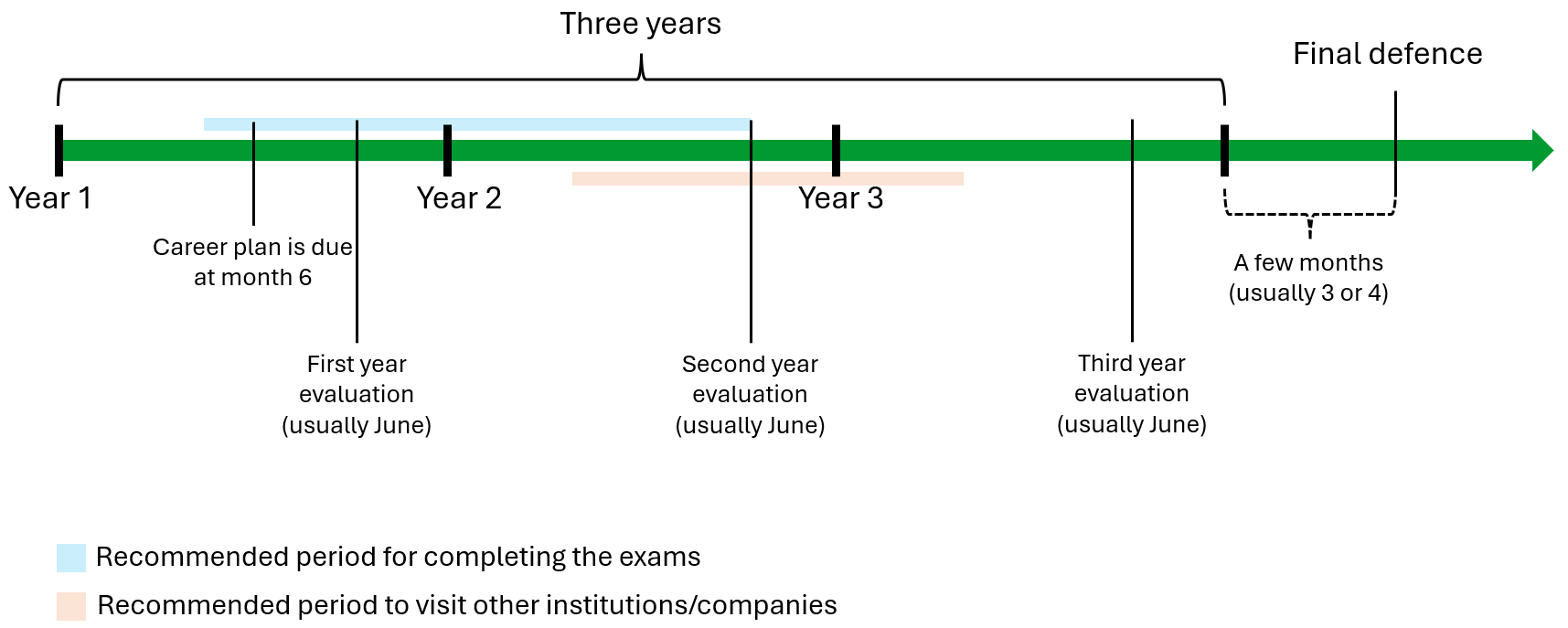
- The student, together with the tutor and co-tutor, must prepare a Career Plan (check Career Plan) and email it to the Doctoral Secretary (check Contacts) within MAXIMUM 6 months from the start.
- The student must attend courses and pass the exams to obtain the required number of credits (check Requirements). The recommended timeframe to complete all credits is between the 6th and 24th month.
- Every year, around June, all PhD students must prepare a report of all activities carried out in the previous year. PhD students' activities will be evaluated by a committee as part of a yearly evaluation (check Yearly evaluation). After positive evaluation, the PhD student is admitted to the next year or to the submission of the thesis for the final PhD defence.
- The recommended timeframe for visiting foreigner institutions/companies is between 18th and 30th month.
- The final thesis is usually due around September 30th, at the end of the third year. The due date depends on the official starting day of the PhD program and other factors (e.g., suspensions or deferrals). It will be communicated in advance by the Doctoral Secretary and it is a sharp deadline.
- The thesis is sent for review to three external reviewers who will send their comments for improvement and their evalution of the thesis. Once ready the thesis will be officially submitted and the PhD board will organize the final defence.
- The final defence is usually about 3 to 4 months after the thesis is submitted, depending on organizational issues. It is usually on the same day for more than a PhD candidate.
- There is no explicit minimum requirement for the number of publications to obtain the PhD degree because Computer Science is vast and different subdisciplines have different pace of publication. It is common to see PhD students at the final defence with more than 2 journal papers and 2 conference proceedings.
-
It is mandatory to obtain 12 credits (or CFU, the Italian equivalent to ECTS) during the three years, by attending courses and passing exams.
- 5h = 1 CFU
- Courses can be selected from the Doctoral Catalougue of UniMI https://www.unimi.it/it/corsi/corsi-post-laurea/corsi-di-dottorato-phd/catalogo-degli-insegnamenti-la-formazione-dottorale or from other institutions outside Unimi.
- Unimi courses require enrollment (usually by the 27th of the previous month) and are taught if at least three students enrolled by the deadline. At the end an evalutaion is mandatory.
- PhD courses taken from other institutions or summer schools can also be consider to obtain up to 6 CFU overall, but the procedure is different. In fact, courses must last at least 10 hours, a maximum number of 4 cfu can be considered for a single course (even if it lasts more than 20 hours), a final exam is mandatory and, the CFU must be explicitly approved by the PhD board. To this end, at the end of the external course, once the exam is passed, the professor must inform the Doctoral Secretary sending an email (or, an official letterhead from his/her institution) specifying: i) the title of the course, ii) the duration in hours (NOT CFU, ONLY hours), iii) when the course took place; and iv) the grade of the exam. The grade can be either a simple "passed" or a number on a scale (e.g., 8/10, 25/30).
- IMPORTANT: only specific PhD courses and summer schools can be considered. Master classes are discouraged and cannot contribute CFU during the PhD.
-
It is mandatory to take course provided by UniMI on transferable skills (usually 72 hours in the three years). Examples of topics are placement, research funding, intellectual property... Since three years these "transversal" courses are organized in weeks.
- Three weeks are organized each year and attendace of one week is compulsary! (you choose one). Registration is compulsary!
- The number of hours attended are registered by the organizers of the courses. The Doctoral Secretary does no track the hours! Once a year, PhD students will receive an email from the central offices of UniMI containing the number of hours attended overall.
- It is highly recommended to attend ALL courses as soon as possible. Otherwise, the PhD defence will be further postponed!
- More information and contact details can be found at https://www.unimi.it/en/study/postgraduate-study/doctoral-research-phd-programmes/following-your-plan-study/soft-skills-phd-students
Download the Career Plan's template here.
The PhD Student together with the tutor and cotutor prepares, at most within the 6th month but earlier is recommended, a career plan in which she/he indicates the theme on which she/he will work, the expected objectives of the research and the secondments abroad.
Suggestions for its preparation:
- The plan must contain a brief overview of the problems tackled and the main objectives set by the student within the 3-year PhD program.
- As any plan, it may change along the way and, at time of its preparation, it should not considered as a definite plan.
- It is higly recommended adding a possible destination abroad to visit other institutions.
- Add a list of possible conferences and journals where the research will be presented/published.
- Add a timeline or GANTT chart to show when each activity will be carried out
The process to submit the plan:
- MUST be submitted within the first 6 months of the PhD program.
- It is prepared, signed by both student, tutor and cotutor, and sent by email to the Doctoral Secretary.
- Each PhD student gets 1650€ a year as personal funds (also called: "dote dottorale", "budget di ricerca", or even "10% additional budget for research activities under Ministerial Decree 226/2021"). However, money becomes available only at the beginning of each solar year (not "PhD" year) when the University of Milan open the new budget.
- The personal funds are provided by the Ministerial Decree 226/2021, and they correspondes to at least the 10% of the Ministerial scholarship. So, all PhD students will receive these funds, as personal funds, during the PhD program.
- The funds are denoted and split into three unique codes, one for each solar year, which will be provided to the students as soon as they are ready (or in most cases the PhD Students can get them authonously on U-WEB, see later).
- The codes of the funds must be communicated every time a purchase is necessary. DON'T LOSE them!
- Funds not spent the previous year will accumulate. For example, 1000€ of funds spent at the first year will accumulate to 650€ + 1650€ at the beginning of second year.
- The funds are personal, so the PhD stundent decides how to use the funds! They cannot be used to cover costs of the lab in which the student is hosted. Examples of typical usage: missions, computers.
- All physical purchases (e.g., laptops) must be returned to the Doctoral Secretary at the end of the third year.
Suggestion: discuss with the tutor for the optimal expenditure of the funds.
Very important: the Doctoral School can not keep track of the expenses done by its PhD students, which are available only to the Central Unimi Offices. So, the PhD student must keep track of all expenses done with the personal funds. Even if from fall 2025 most PhD Students can visualize their funds on U-WEB, you still need to keep as the reimbousement process takes time.
Since fall 2025, PhD Students, who have a PhD fellowship funded by UniMI, can autonomously download an Excel file with all the expenses already reimbursed on her/his personal funds and the remaining available amount on the UniMI U-WEB Reporting web site. On this page, PhD Students can also check the exact codes of personal funds.
The University must provide transparency of what paid to everyone. At the following link https://www.unimi.it/it/ateneo/amministrazione-trasparente/pagamenti-dellamministrazione/dati-sui-pagamenti, PhD students can retrieve what the University has already payed for each of them. Use the link as a last line of action to keep track of what was already reimboursed (e.g. for missions) and payed (e.g., scholarship or teaching).
In some cases, the laborotory or the PhD tutor provides a computer or laptop for the activities related to the PhD. If this is not the case, it is possible to borrow a laptop from the PhD Secretary, which must be given back at the end of the PhD career. In the past, the PhD Board was keeping a stock of computers, but they were getting obsoletes too quickly. So at the moment, when a computer is needed it is then acquired.
Things to consider:
- Max 1000€ (VAT included). This is the amount planned for each computer. If the laptop is more expensive, it is necessary to idetify a second fund to cover the remaining costs (for example from the supervisor, or the "dote di ricerca").
- An extended warranty should be included for both PC or Apple computers (Apple Care+ in the latter case) because repairments cannot be done using the personal funds.
- It is strongly suggested, unless special needs, to select a machine among the ones for which the University of Milan has a special agreement, as the discounts are relevant. At the link https://work.unimi.it/aree_protette/123476.htm, all the necessary information and forms are available. Once you decided what can suit you and discussed with your supervisor, please write the PhD Secretariat with this information:
- PC/Mac Model and optionals (e.g. "Lenovo ThinkPad X1 2-in-1 Gen8 with optional SSD L2.3-SSD1TB")
- Expected cost including VAT: (e.g. "1.369,90€ + 22% VAT = 1671,28€")
- Code of the fund to use for the amount exceding € 1000 (e.g. "PRIN202223ABCDE_02")
The term "mission" refers to all those activities performed outside Unimi. Missions require MANDATORY authorization and must be APPROVED BEFORE departing to perform the activity. Requesting a mission is done by filling out the mission form. Without the authorization, the PhD student is NOT covered by the health insurance and it is NOT eligible for reimboursement!
Typical missions are: attending a conference, participating to a summer/winter school, delivering a seminar in another university, visiting abroad, ...
Important: missions in Milan require authorization as well, but transportation in this case is not subject to reimbursement!
Very important: missions abroad, not only require authorization, but the forms must be sent to the central officies using INFORMASTUDENTI. Read below for details.
The process to request authorization, 20 days before departure, for a mission is the following:
- Authorization MUST be requested BEFORE (no exceptions)!
- Discuss the opportunity and the objectives with the tutor. Then prepare the authorization request form(s):
- for missions in ITALY, fill and sign the form: Authorization for periods of stay in Italy.pdf;
- for missions ABROAD, fill and sign the form: Authorization for travel abroad addressed to the PhD Coordinator.pdf AND Authorization for the period of stay abroad addressed to the University Rector.pdf
- Understand whether the mission should come with a reimbursement for the PhD student. If yes, gather the code of the funds (either the one of personal funds or another one provided by the tutor).
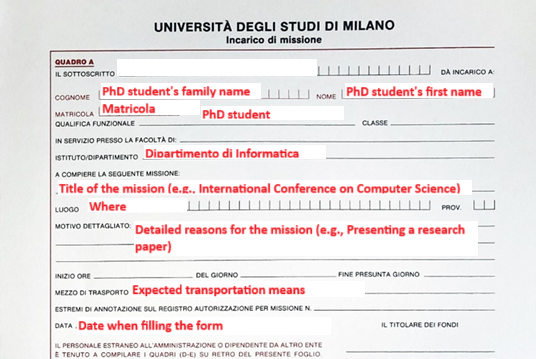
- Get the mission form in person from the Doctoral Secretary. THIS IS ONLY A PAPER FORM AT THE MOMENT.
- Fill out the form as in the example. Only the red sections must be filled out at this moment.
- Is the mission lasting 10 or more days? If yes, the PhD student may request a scholarship increase of 50%. Please refer to what specified in the Visiting abroad section for authorizations and certificates.
- Take the mission form + the authorization request form(s) (and the scholarship increase form if eligible) to the Doctoral Secretary for obtaining the authorization 20 DAYS before departure.
- For missions ABROAD, send Authorization for the period of stay abroad addressed to the University Rector.pdf signed by the PhD coordinator to INFORMASTUDENTI. In case an increase in scholarship is requested, send to INFORMASTUDENTI the authorization signed by the PhD coordinator too (see Visiting abroad section).
- TAXI should be avoided as much as possible and authorized before (sic!) departure. The same for a rented car. Find in the box below the list of documents for authorization or ask the PhD Secretary.
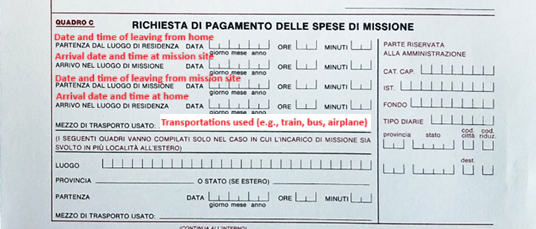
When back from the mission:
- Gather the mission form from the Doctoral Secretary.
- Fill out the form as in the example. Only the red sections must be filled out at this moment.
- Fill out the reimbursement list of expenses and attached all receipt. Do not forget to add the currency of the receipts.
- Take the form to the Doctoral Secretary.
Following a non-comprehensive list of requirements for the receipts (read the full regulation at the link reported below this section):
- Only for missions in Italy: the expenses for accomodation, food, registration to conferences/schools, and extraordinary means of transport (taxi or rental car) must be traceable, meaning that all receipts must come together with a copy of the bank account statement to prove that the payment was done using a traceable method. If payed in cash, the reimbourse will be taxed! If the receipt reports "electronic payment/paid with card" or similar, the bank account statement may be not necessary (but why risking? Collect all of them and bring them home with you).
- For public transportation: must gather both receipts and related tickets or boarding passes.
- All receipts must be attached to the mission form in original. The only exceptions are for digital receipts.
- Personal purchases are not refundable (e.g. from the receipts of the supermarket, you will have to exclude the reimbursement of any purchase that does not concern food and beverage)..
Please, be aware that without the mission form no reimbursement will take place. The reimborsement is not immediate and may take several days.
VERY IMPORTANT: Only certain purchases are eligible for a reimbursement! The full regulation is available at https://www.unimi.it/it/ateneo/normative/regolamenti/regolamento-spese-di-missione-e-mobilita. Following a brief recap of certain important aspects to consider:
- 4-8 hour mission=1 meal reimbursed, 8-12 hour mission=2 meals reimbursed. If possible, obtain one receipt per meal!
- For stays requiring hotels, highly recommeded to have breakfast included in the hotel receipt to avoid problems in reimbursement (even though, according to the new regulation, breakfast can be seperated from the hotel receipt; Art. 10.1d and 10.2b).
- The money reimbursed for meals depend on the country (Allegato 3, Tabella B).
- Double rooms for single use are almost never completely reimbursed.
- The use of taxi and other forms of mobility (e.g., rented bike/car, owned car) must be authorized by the funds owner and well motivated (for example, lack of public transportation). Download here the request form for taxies and here the request form for rental cars. Fill the necessary forms prior the departure, and attach the forms to the authorization request.
- Booking in a AirBnB is almost always never completely reimboursed even if cheaper than hotel rooms!
- Attach all receipts including tickets and boarding passes to the reimbursement list!
- When the receipt is not written in English, French, German or Spanish language, the PhD student must attach (Art. 10.2b): i) a translation of the receipt; and ii) a self-declaration document attesting the truthfulness of the translation.
- Shared room with single payment: In many circumstances, PhD students may find convinience to share a hotel room but the payment cannot usually be split at time of booking. To get the reimborsement in this case, the payer will have to attach to the mission form the original receipt and must request for only the expenses concerning to his/her stay. The others sharing the room, they must attach a copy of the receipt, a copy of the bank transfer to the payer (therefore, no cash allowed) and a self-declaration (text document, dated and signed) declaring that the payment was done by a specific colleague.
In certain circumstances, it is possible to ask the department to anticipate the payment of conference fees, hotel stay and transporation. It requires time from an administrative perspective so DO IT IN ADVANCE AND EARLIER THAN 20 DAYS BEFORE. Typically some limits exists:
- Usually expenses of at least 500€ (Art. 8.1).
- The request must be done at least 15 working days (NOT calendar days, so more than three weeks), before the departure for the mission (Art. 8.2).
- The reimbousement must be requested ritorning the mission form and all necessary receipts within 30 days (Art. 8.3).
- If, for any reason, the PhD student without a serious motivation is not able to complete the mission already payed, the University could decide to take back the amount anticipated from the scholarship (Art. 8.4).
Visiting another institution abroad is a unique opportunity to grow professionally. It enlarges the network, provides more chances for job and post-doc opportunities after the PhD program, improves the technical skills, helps to publish more, shows how other teams organize and tackle scientific challenges, etc. Therefore, it is highly recommended to plan several months abroad.
The typical stay lasts from 4 to 6 months; 6 months is likely the most effective amount of time. It is usually not recommended less than 4 since the first few months are often full of errands to complete (bureaucracy, housing, insurance, ...). The optimal period for visiting abroad is between the half of the second year and half of the third one.
Following are the steps to request and get authorization to visit another institution abroad:
- Talk to your tutor and identify a suitable institution. This must be done as early as the first 6 months and specified in the Career plan. You may decide to contact the hosting institution 1 year or more in advance for a preliminary check on the feasibility.
- Contact the hosting institution and understand the bureaucratic needs.
- Fill out the mission form as described in Missions (same rules apply, so plan and fill the forms in advance!). In particular, remember to download here the form to request the 50% increase of the scholarship, fill it out and take it to the Doctoral Secretary.
When at the hosting institution:
- Within the first days of a new month, ask your international supervisor to sign the attendance form (download here) to receive the increment in the scholarship. Without the signed form, no increase in scholarship will be provided. Read carefully the requirements in the attendance form! It The form must be sent to INFORMASTUDENTI.
- If any, collect all receipts eligible for reimbursement (e.g., flight tickets). The reimbursement requires all the information and steps presented in Missions (e.g., fund code, agreements, forms).
Very convenient: there are opportunities to visit abroad and get funded for that (in addition to the increase of the scholarship). It usually requires to write a project proposal of what will be done during the visiting period and mandatory physical attendance (not remote working). An introduction to some of the funding opportunities are shown in the following presentation, which includes Erasmus opportunities and other interesting ones.
Summer/winter schools are an exceptional way to gather new knowledge and network with peers.
Finding the most suitable schools is however challenging. Thanks to the efforts of PhD students, at the following GitHub link https://github.com/Bixio999/PhDSummerSchools, PhD students can find a list of possible schools.
Please, follow the instructions for Missions to request authorization to participate.
Important: PhD students are encouraged to contribute to the archive. To do so, you must first fork the repository on GitHub. Afterward, edit the README file (you can do this directly on the website). If you wish to add a new research topic, add a new entry in the Table of Contents with a unique ID (refer to the existing entries for guidance). Then, write the section and include summer and winter schools for each row in the list. Optionally, you can provide a brief description of the school and/or additional information about acceptance and CFU validation (if you have attended). Finally, commit the changes to the file and submit a pull request to the main repository.
Every year, around June, all PhD students must prepare a report of all activities carried out in the previous years. A similar report will be prepared by the PhD supervisor, but it will be blind to the PhD student. Both reports will be evaluated by a committee specifically entitled to assess the status of the PhD journey. At the end of the second year and third year (approximately in JUne or July), PhD students will deliver a presentation related to their PhD activities and plans to the committee. The committee will provide feedbacks to the PhD students.
Very important: the committee might stop the PhD career of a PhD student when results are not sufficient!
Here are some guidelines to prepare the report and presentation:
- Get them ready in June! The exact submission date and presentation date will be sent by email as close as one week before. The late notice is unfortunately unavoidable due to previous commitments of the evaluating committee.
- Follow the instructions in the template.
- It must report all the activities done in the previous years and a specific section or paragraph with the achievements of the last year.
- It must clearly report i) the scientific objectives (very important); ii) the results obtained so far; iii) the planned visits and those already done; iv) the list of planned courses and the CFU already obtained; v) the list of conferences/summer schools planned and those already completed; vi) the list of publications; vii) all other activities, along with their details, such as volunteering for scientific societies, involvement with the general public (e.g. MeetMeTonight), teaching activities, external work.
- The report must include the expenses requested for reimboursement, their fund code and the amount already reimboursed. Keep track of all these information!
Download the PhD student's template here.
Download the Tutor's template here.
Subscribing to scientific societies may be beneficial for the PhD student for reasons such as expanding the network, getting involved in volunteering activities, and many others. The subscription often provides a discount for the events they organize (typically conferences).
The subscription fee can get reimboursed only if approved by the Computer Science Department. The approval can be granted only if the following steps are strictly follewed.
Following are different cases for the reimbourse of the subscription fee.
Case 1: The PhD student has to attend a conference for which the subscription fee is required and for which it permits a significat discount.
- Together with the preparation of the mission form, the PhD student downloads the form available here, fill it out digitally and print it.
- The printed form must be given to the Doctoral Secretary BEFORE the departure date reported in the mission form.
- The receipt of the payment of the subscription fee must be attached to the mission form when returned from conference.
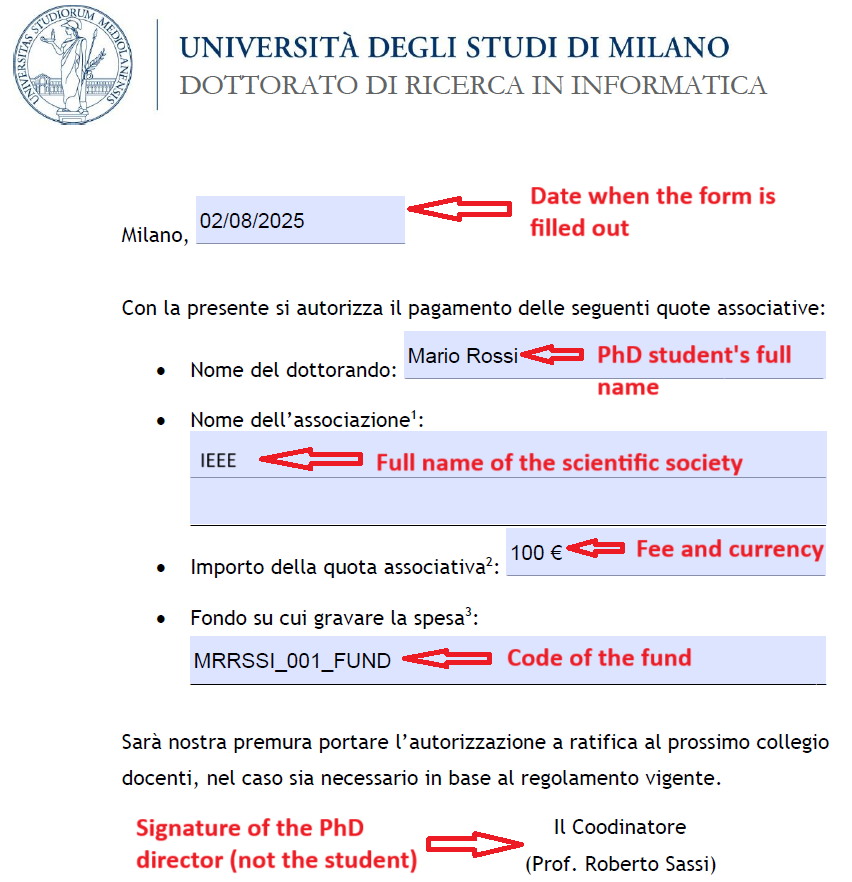
Case 2: The PhD students wants to subscribe to a scientific society, unrelated to any conference attendance.
In this case, the PhD Student discusses with her/his supervisor the opportunity of becoming a member of the scientific society and then fills the form specified in the previous case. However, in this case it is signed also from the tutor and then taken directly to the PhD Secretary Office.
PhD students are allowed to support teaching activities through two different modalities. Following are some rules and steps:
- To engage with teaching activities, PhD students will be notified by email regarding the mandatory subscription to the teaching registry ("albo" in Italian). This requires the PhD student to participate to a public call (art. 45), where each call has specific documents to fill. Without the registration of the PhD student to the "albo", NO TEACHING activities are allowed.
- Since 2025/2026, the enrollment to the teaching registry will be valid for 3 years. However, the rules to apply depend on the public call for which the PhD student has applied to.
- Max 100 hours a year.
- The two modalities are i) tutoring ("tutorato" in Italian); ii) supplementary teaching ("didattica integrativa" in Italian), e.g., art. 45.
The PhD journey is a full time activity not compatible with other forms of remunerated jobs. However, the PhD student may be authorized to perform several hours of external work if the commitment requested will not hamper the progress of the PhD journey. The request is done by filling the form (download here in Italian, and here in English) and sending the signed form to the PhD Secretary Office along with a draft of the contract. The request will be evaluated by the Doctoral School and the final authorization will be confirmed to the PhD student.
Very important: The process may take up to 1 month and MUST BE DONE BEFORE SIGNING ANY CONTRACT.
The Department of Computer Science provides several IT services including printers, badge activation, servers for GPU computing, etc. The full list is available at https://servizi.di.unimi.it/doku.php?id=start.
Some of the services provided by the CS Department and UniMI are:
- For activating the badge to enter the deparments and lab, click here.
- For borrowing equipments, click here.
- For using the gitlab server of the department, click here.
- The department provides computing resources through a platform named "Ampere". Read the instructions here. The service requires booking a timeslot and can be done here
- A list of software (e.g., Matlab, Overleaf, Wolfram mathematica) provided by Unimi is also available at https://work.unimi.it/servizi/servizi_tec/1268.htm
- A Microsoft Campus Agreement is also available at https://work.unimi.it/servizi/servizi_tec/1536.htm
- Many others...
PhD students are eligible of several welfare possibilities provided by Unimi.
- See here for welfare related to meals.
- See here for welfare related to additional health insurance. For international students, this is not a valid solution for requesting the "Permesso di Soggiorno". Enroll in the National Health System first and, if you need, consider this additional private insurance.
- PhD coordinator of the Doctoral School in Computer Science: Roberto Sassi (roberto.sassi at unimi.it, sixth floor)
- Doctoral Secretary: Sara Chiurco (segreteria.dottoratoinformatica at unimi.it, third floor)
-
PhD representatives:
- XXXVIII cycle: Davide Rusconi
- XXXIX cycle: Michele Fiori
- XL cycle: Vincenzo Lombardo
- XLI cycle: Matteo Manzoni